
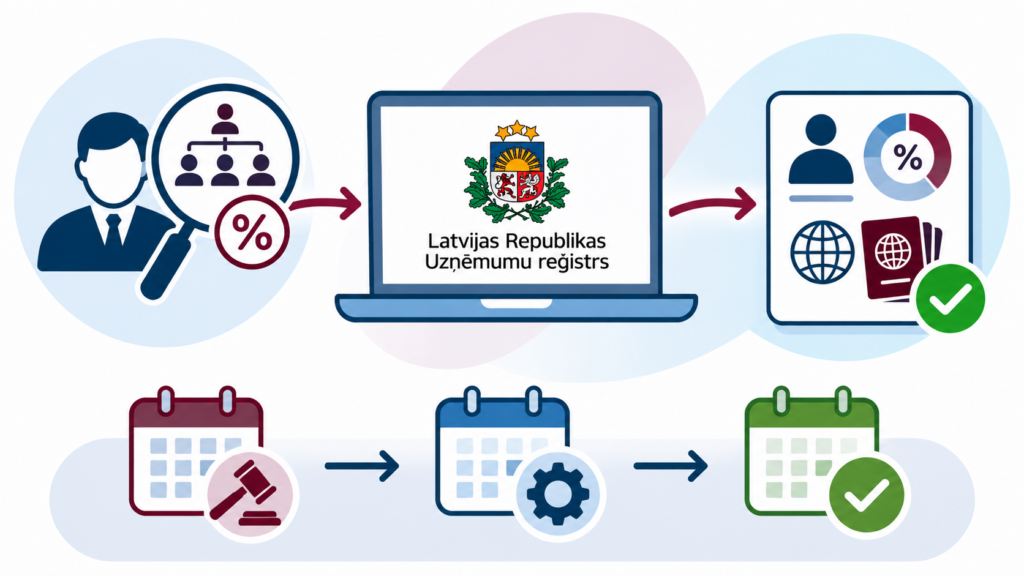
The amendments to the Law on the Prevention of Money Laundering and Terrorism and Proliferation Financing, adopted on 3 December 2025 and entering into force on 1 April 2026, introduced changes to the requirements concerning information to be registered about beneficial owners (hereinafter referred to as BOs). The regulatory framework has been improved to ensure compliance with European Union requirements for adequate, accurate and up-to-date information on beneficial ownership.
The new requirements concerning the scope of information to be submitted to the Register of Enterprises entered into force on 1 July 2026, while the Register of Enterprises updated its practice on 5 October 2026. Under the new requirements, information about BOs must also include the extent of control exercised and all nationalities held by a BO, where the person has multiple nationalities. This information must be updated whenever a new BO is registered, changes are made to existing BO information, or other changes occur that require BO information to be updated.
Extent of Control Exercised by a Beneficial Owner
The type of control describes the legal basis on which control over a legal entity is exercised, whereas the extent of control indicates the degree to which a BO actually exercises control over that entity. The extent of control must be specified separately for each type of control and cannot be combined into a single general statement.
This requirement is intended to ensure that the legal basis and extent of control exercised by each BO are clearly and transparently identified.
Where control arises from ownership rights or voting rights, it must be expressed as a percentage. For example, this applies where a BO is a shareholder holding 100% of a company’s share capital.
Where the extent of control cannot be expressed as a percentage, it must be provided in a brief description explaining the person’s actual influence over the legal entity. For example, a BO may exercise effective control by holding a position as a member of the management board with the right to represent the company individually.
Extent of Control Arising from Ownership Rights and Voting Rights
The extent of ownership rights and voting rights in a company may differ. Such situations commonly arise where a company has several classes of shares, some of which do not carry voting rights. Both ownership interests and voting rights must be expressed as percentages, reflecting direct and indirect participation in the legal entity.
Where control is exercised indirectly through another legal entity, the extent of ownership rights and voting rights must be determined based on the shareholding and voting rights held in that intermediary legal entity.
For example, Company B (SIA “B”) holds 50% of the share capital and voting rights in Company A (SIA “A”). Individual C holds 70% of the share capital and voting rights in Company B.
Since Individual C is identified as the BO of Company A through indirect control, Individual C is considered to hold an indirect ownership interest and voting rights amounting to 35% in Company A.
Describing the Extent of Control
The extent of control exercised over a legal entity must be described in writing where it cannot be objectively and accurately expressed as a percentage. The description must be brief and specific.
This is necessary where a percentage does not accurately reflect the BO’s actual influence or where the legal entity does not have share capital, shares or voting rights in the sense applicable to capital companies.
For example, this may apply where a BO holds 80% of a company’s shares and is a member of its management board but is only authorised to represent the company jointly with the chairperson of the management board. It may also apply where a BO must be identified in an association.
Nationality of a Beneficial Owner
Information on nationality must be provided where the BO is not a Latvian citizen or has not been assigned a Latvian personal identity number.
The amendments require BO information to include all nationalities held by the individual, together with the details of the identity documents supporting those nationalities.
For example, where a BO holds both Danish and Norwegian citizenship, both nationalities must be declared, along with the details of the identity documents issued by the respective countries.
Are All Companies Required to Update Their Beneficial Ownership Information Immediately?
The entry into force of the new regulatory framework does not, in itself, mean that all companies must immediately submit a new application to the Register of Enterprises.
The transitional provisions stipulate that, in certain cases, the Register of Enterprises will independently register information already available to it concerning the extent of control exercised by BOs by 31 December 2026.
Where the necessary information has not yet been registered, the missing details concerning the extent of control must be submitted together with the next update of BO information.
Particular attention should be paid to cases where a BO has not been identified in the Register of Enterprises by a Latvian personal identity number. In such cases, up-to-date information concerning the BO’s nationality or nationalities, if not already submitted to the Register of Enterprises, must be provided by 31 December 2026.
Companies are therefore advised to review their existing beneficial ownership information registered with the Register of Enterprises to determine in good time whether additional information must be submitted.
How Can ZAB EmRo Assist with Updating Beneficial Ownership Information?
ZAB EmRo provides legal assistance in reviewing and updating beneficial ownership information with the Register of Enterprises.
Our legal professionals can help assess whether existing BO information complies with the current requirements, determine the type and extent of control exercised, including in cases involving complex ownership structures, and prepare the necessary documents and applications.
By entrusting this process to ZAB EmRo, you can save time and reduce the risk of submitting incorrect or incomplete information.
We invite you to contact ZAB EmRo to ensure that your company’s beneficial ownership information complies with the applicable legal requirements in a timely manner.
This article does not constitute legal advice for any specific situation. Appropriate legal solutions may vary depending on the particular facts and circumstances of each case.
Article written by: legal assistant Elīna Vītola