
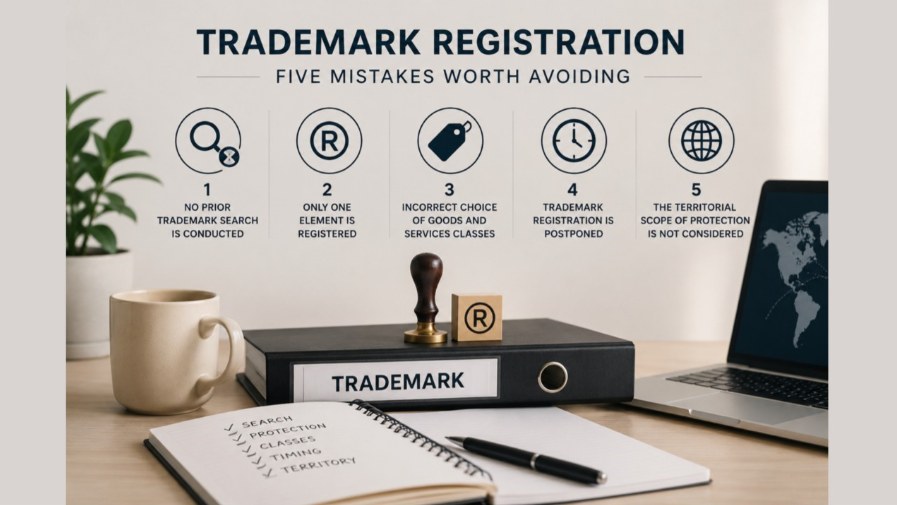
1. No prior trademark search is conducted
One common misconception is the belief that if a company name is registered in the Commercial Register, or the corresponding domain name is available, it can safely be used as a trademark as well. However, registering a company name does not in itself mean that no earlier trademarks with an identical or similar sign exist. It is therefore advisable to carry out a thorough search of the relevant trademark registers before filing an application, in order to identify potential risks at an early stage.
2. Only one element is registered
Many companies choose to register only their logo, without giving proper consideration to protecting the word mark. If the company later changes the logo design, the original registration may no longer cover the new visual identity, whereas a word mark protects the name itself regardless of its graphic presentation. In certain cases, it is worthwhile to register both the word mark and the figurative mark, thereby ensuring broader and more durable protection.
3. Incorrect choice of goods and services classes
Trademark protection covers only the goods and services specified in the application according to the Nice Classification. If unsuitable or overly narrow classes are chosen, the company’s future activities may not be fully protected, while an excessively broad list of classes is not always an optimal solution and can lead to unnecessarily high costs. The choice of goods and services classes for a trademark should be based both on the company’s current activities and on its development plans.
4. Trademark registration is postponed
Companies often invest first in advertising, packaging, and website development, and only afterward consider trademark registration. If it later turns out that the chosen name cannot be registered, or that it infringes the rights of another party, the company may be forced to change its entire brand identity, resulting in significant additional costs. Timely trademark registration helps reduce this risk.
5. The territorial scope of protection is not considered
Companies planning to expand beyond Latvia, or already operating in other markets, often register their mark only locally, without considering the option of a European Union trademark or international registration. If growth is planned, it is worth thinking about the scope of protection in advance, since expanding protection later can be more costly and take longer.
Article written by: legal assistant Amanda Račiņa