
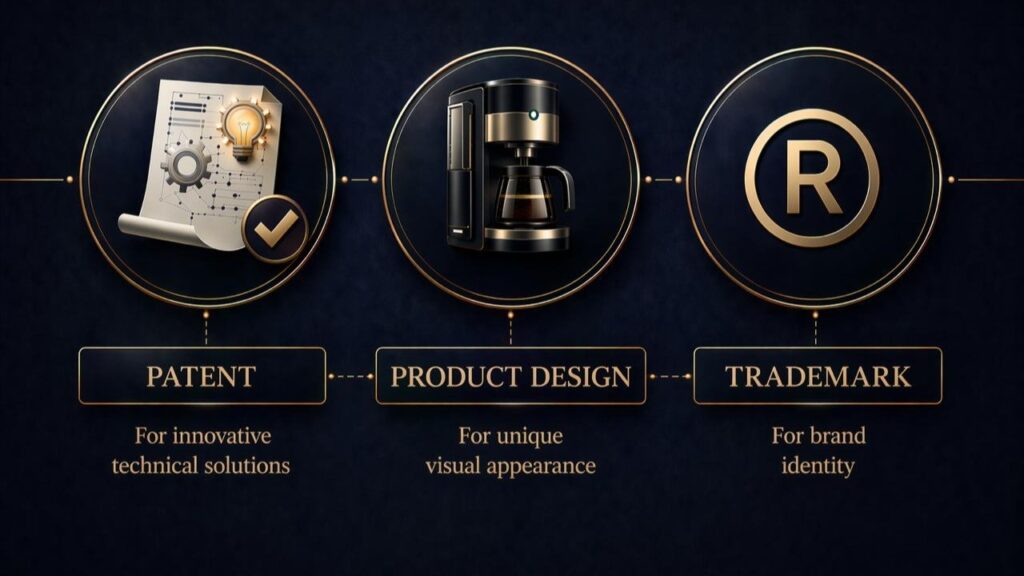
These terms are often used interchangeably; in practice, however, they protect entirely different business assets.
A patent protects a new invention – a technical solution to a specific problem. To obtain a patent, the solution must be new, involve an inventive step, meaning that it must not be obvious to a person skilled in the art, and be susceptible of industrial application.
A design protects the external appearance of a product – its shape, lines, colours, ornamentation or surface texture. Design protection does not extend to the functionality of a product but concerns its visual impression. Registration requires novelty and individual character, meaning that the design must stand out from existing designs.
A trade mark protects a sign that identifies a company’s goods or services and distinguishes them from those of others. It may be a word, a logo or a name. To be registered, a trade mark must be distinctive and must not be misleading or overly generic.
If you are planning to develop a product or a brand, it is advisable to assess the most appropriate form of protection at an early stage. Please do not hesitate to contact ZAB EmRo for assistance in choosing and securing effective protection of your industrial property.
Image created using AI.
Article written by: Amanda Račiņa